
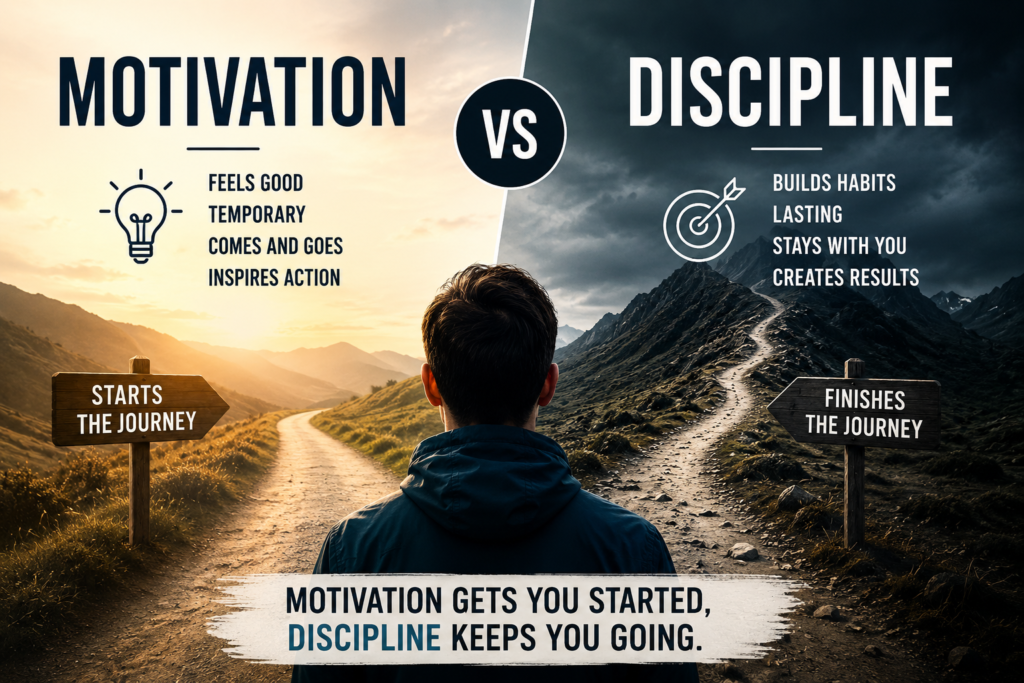
Why do some people achieve their goals while others give up? The answer often lies in the difference between motivation and discipline. Discover how discipline turns good intentions into lasting results.
Every person wants to achieve something.
Some want to get fit. Some want to build wealth. Others want to learn a new skill, start a business, write a book, or improve their lives in some way.
When people begin a new journey, they often look for motivation. They watch inspiring videos, read powerful quotes, and listen to successful people talk about their achievements. For a moment, they feel energized and ready to conquer the world.
But then something happens.
The alarm clock felt easy to ignore. The workout felt easier to skip. The book stayed closed. The goal that once seemed exciting slowly moved to the background.
If this has happened to you, you’re not alone.
This is where many people quit.
The problem is not that they lack talent or intelligence. The problem is that they rely too heavily on motivation and not enough on discipline.
So which one is more important? Motivation or discipline?
The answer may surprise you.
What Is Motivation?
Motivation is the feeling that makes you want to take action.
Motivation creates a sense of possibility.
It gives us the emotional push to begin something new. It creates excitement and helps us imagine a better future.
It reminds us that change is available if we’re willing to act.
Without motivation, many great journeys would never begin.
Motivation feels great because it creates momentum. It helps us begin.
For example:
- You watch a fitness transformation video and decide to start exercising.
- You read a book about investing and feel excited to improve your finances.
- You listen to a successful entrepreneur and suddenly want to start your own business.
Motivation often acts as the spark that lights the fire.
Without motivation, many people would never start.
However, motivation has one major weakness.
It doesn’t last.
The Problem With Motivation
Motivation is based largely on emotions.
Motivation often comes and goes without warning.
Some mornings you wake up feeling ambitious and productive. Other mornings you feel tired, distracted, or overwhelmed.
Life happens.
Unexpected problems appear. Work becomes stressful. Energy levels change. Priorities shift.
When action depends entirely on motivation, progress becomes inconsistent.
You work hard when you feel inspired and stop when you don’t.
The result is a cycle of starting and stopping.
Many goals fail not because people lack ability, but because they wait to “feel motivated” before taking action.
Yet successful people continue doing these things even when they don’t feel like it.
Why?
Because they have developed discipline.
What Is Discipline?
Discipline is choosing to do what needs to be done, even when you don’t feel like doing it.
Interestingly, the word discipline is often linked to the word disciple, which means a follower. A disciple follows a teacher, a set of principles, or a particular path.
In a similar way, discipline is about following something consistently.
It is the practice of following the rules, habits, routines, and standards that lead you toward your goals. These rules may come from a mentor, a proven system, or they may be ones you create for yourself.
For example, if your goal is to become financially secure, discipline might mean following a monthly budget. If your goal is to improve your health, discipline might mean following a regular exercise routine and healthy eating habits.
Discipline doesn’t ask, “What do I feel like doing today?”
Instead, it asks, “What action moves me closer to my goal today?”
A disciplined person understands that success is rarely the result of a single big effort. It is usually the outcome of consistently following the right path, day after day, regardless of mood or circumstances.
It is keeping a promise to yourself regardless of your mood.
Discipline doesn’t ask, “Do I feel motivated today?”
Instead, it asks, “What needs to be done today?”
A disciplined person understands that feelings come and go, but commitments remain.
They show up on good days.
They show up on bad days.
They show up when they are excited.
And they show up when they are bored.
That consistency is what creates results.
Motivation Starts the journey; discipline finishes it.
The Difference Between Interest and Commitment
Imagine two people who want to learn a new language.
The first person studies only when they feel motivated. Some weeks, they practice every day. Other weeks, they do nothing at all.
The second person studies for twenty minutes every day, regardless of mood.
After a year, who is more likely to become fluent?
The answer is obvious.
Interest says, “I’ll do it when I feel like it.”
Commitment says, “I’ll do it because I decided to.”
Discipline is commitment in action.
Imagine you decide to run a marathon.
Motivation might get you to buy running shoes and go for your first run.
But discipline is what gets you out of bed on cold mornings.
Discipline is what helps you train when progress feels slow.
Discipline is what keeps you moving when the excitement has disappeared.
The same principle applies to every area of life.
- Motivation helps you start saving money.
- Discipline helps you continue saving every month.
- Motivation helps you start reading books.
- Discipline helps you read consistently for years.
- Motivation helps you begin a business.
- Discipline helps you keep working through challenges.
The people we admire are not necessarily the most motivated people.
They are often the most disciplined.
Why Discipline Creates Freedom
Many people think discipline is restrictive.
In reality, discipline creates freedom.
A person who is disciplined with money enjoys greater financial freedom.
A person who is disciplined with health enjoys greater physical freedom.
A person who is disciplined with learning gains more career opportunities.
Small daily actions may feel difficult in the moment, but they often lead to a better life in the future.
The temporary discomfort of discipline is usually far less painful than the long-term regret of inaction.
What Successful People Understand
People often admire successful athletes, entrepreneurs, writers, and professionals.
From the outside, it may seem as though these individuals are always motivated.
They aren’t.
They experience the same emotions as everyone else.
They have days when they feel tired. They face setbacks. They lose confidence. They encounter obstacles.
The difference is that they don’t allow temporary feelings to determine their actions.
They understand that progress comes from consistency, not inspiration.
That understanding gives them an advantage over people who wait for the perfect mood.
How to Build More Discipline
The good news is that discipline is not something you are born with.
It is a skill that can be developed.
Here are a few simple ways to strengthen it:
1. Start Small
Don’t try to change your entire life overnight.
Small actions performed consistently are more powerful than massive actions performed occasionally.
Read one page.
Do five minutes of exercise.
Save a small amount of money.
Focus on consistency before intensity.
2. Create Routines
The fewer decisions you need to make, the easier discipline becomes.
Turn important actions into habits.
When something becomes part of your routine, it requires less mental effort.
3. Keep Your Promises to Yourself
Every time you follow through on a commitment, you strengthen self-trust.
Every small win reinforces the belief that you can depend on yourself.
4. Focus on the Process
Many people become obsessed with results.
Instead, focus on the daily actions that create those results.
Success is usually a by-product of consistent effort over time.
5. Accept Imperfection
Nobody is disciplined 100% of the time.
You will miss days. You will make mistakes.
The goal is not perfection.
The goal is returning to the path as quickly as possible.
Motivation and Discipline Can Work Together
This isn’t a battle where one must completely replace the other.
Motivation and discipline both have important roles.
Motivation helps you begin.
Discipline helps you continue.
Motivation provides the spark.
Discipline keeps the fire burning.
The problem occurs when people expect motivation to do the entire job.
It can’t.
Eventually, discipline must take over.
The Real Secret to Long-Term Success
If there is one lesson worth remembering, it is this:
You do not need to feel motivated every day to make progress.
You only need to keep showing up.
The person who takes small steps consistently will almost always outperform the person who takes massive action occasionally.
Progress is rarely dramatic.
It is usually quiet.
A workout completed.
A page read.
A skill practiced.
A task is finished.
These simple actions may not seem important in the moment, but over time, they become the foundation of remarkable results.
Motivation is a wonderful feeling, but it is temporary.
Discipline is not exciting. It is not glamorous. It often goes unnoticed.
Yet discipline quietly builds habits, skills, and results that shape a successful life.
Use motivation whenever it appears.
But never depends on it.
Instead, develop the discipline to act whether motivation shows up or not.
Because in the long run, motivation may start the race, but discipline is what carries you across the finish line.